Thirteen units, and a written output from each
One unit per week, with an applied assignment on your own work and a different discussion format each time. 156 in-person contact hours, delivered entirely in Arabic.
We do not teach subjects — we build decision capability
The gap between someone who knows accounting and someone who can make a financial decision is not volume of information. It is the ability to connect it to a specific case under time pressure and missing data. The programme therefore rests on three principles:
First, every unit is measured by an output, not by attendance. Second, assignments run on the participant's real data, not a hypothetical case. Third, review is collective — participants read and challenge each other's work, which exposes gaps an instructor alone would miss.
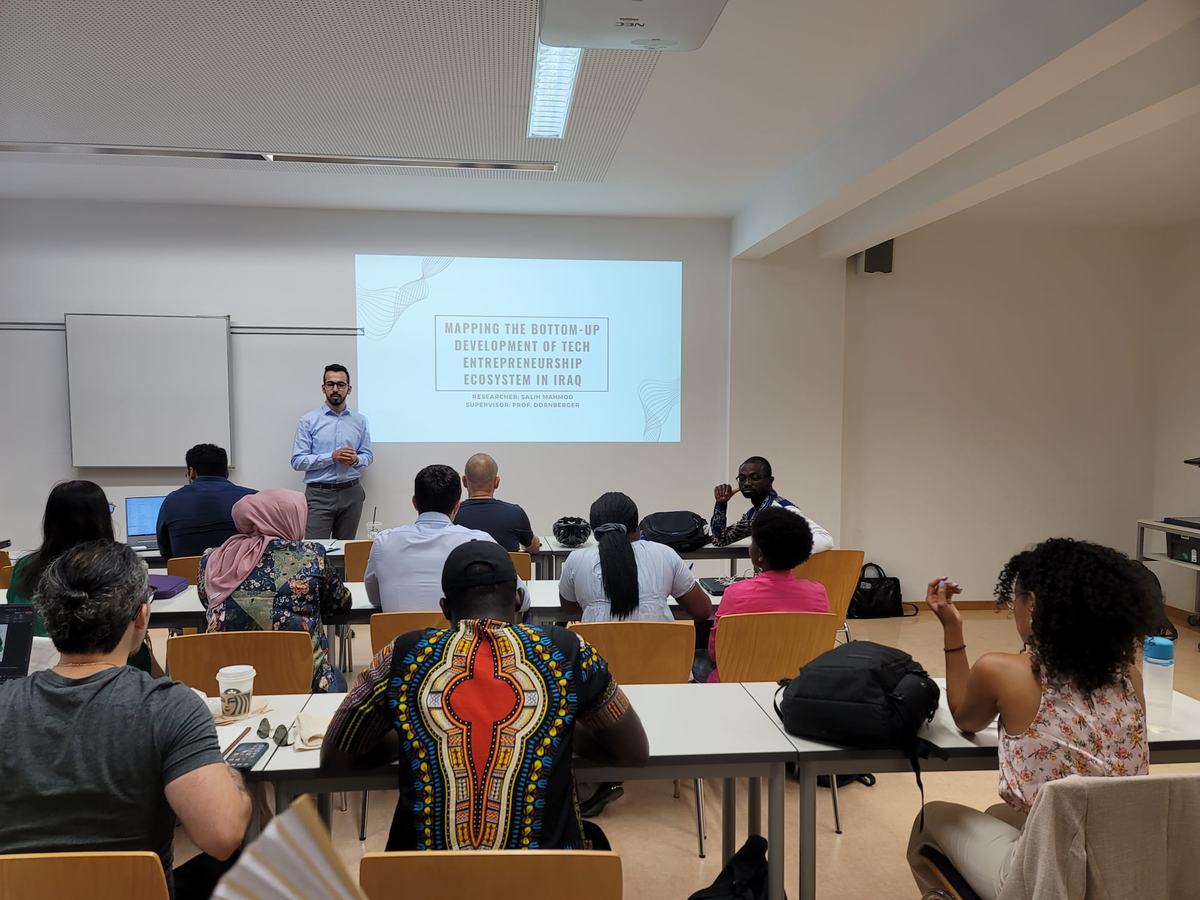
Week by week
Each unit has a clear learning objective and an output you leave the session with.
| Week | Unit | What you learn | What you leave with |
|---|---|---|---|
| 01 | Local Economic Development | Reading the city's economy: sectors, where demand forms, and where growth actually sits. | A map of your sector and where your organisation sits in it. |
| 02 | Entrepreneurship | Turning an idea into a business model you can test before spending money on it. | A written business model for your venture or a new line of business. |
| 03 | Formal Economy & Legal Framework | Registration, contracts and tax obligations — and the cost of staying informal. | A compliance checklist specific to your organisation. |
| 04 | Accounting | Reading financial statements and cost structure well enough to decide — not to keep the books. | A cost-structure analysis of your product or service. |
| 05 | Financial Management | Cash flow, pricing and investment decisions: when to spend and when to hold. | A twelve-month cash-flow model. |
| 06 | Marketing & Market Research | Defining the segment, building the value proposition, and measuring what works. | A quarterly marketing plan with measurable indicators. |
| 07 | Sales & Negotiation | Building a sales funnel, handling objections, and negotiating on value rather than price. | A sales script and a negotiation scenario rehearsed in session. |
| 08 | Supply & Value Chains | Mapping the chain from supplier to customer, and exposing waste and points of risk. | A value-chain map with three defined improvement opportunities. |
| 09 | Innovation Management | Generating solutions and testing them at the lowest possible cost before committing. | A designed innovation experiment, ready to run. |
| 10 | Leadership & Strategy | Turning ambition into a plan with objectives, indicators and clear ownership. | A one-page strategy map. |
| 11 | Capability Development | Role definition, delegation and performance measurement — and building your successor. | A development plan for your team or your own career. |
| 12 | Project Management | Scope, schedule, resources and risk, with tools that get used rather than filed. | A complete project plan for a real initiative. |
| 13 | Academic & Commercial Research | Framing the question, gathering data, and reaching a conclusion that survives scrutiny. | A research design for a problem in your own work. |
Two units run as group work: supply and value chains, and innovation management — participants work in teams on a single case, because neither subject is mastered alone.
The 90-day plan
The programme does not end in an exam. It ends in an execution plan that is yours alone.
In the final weeks each participant builds a 90-day plan for a goal they choose: launching a venture, fixing a department inside their company, or reaching a specific role in a target sector. The plan is built with the tools learned during the programme — objectives, indicators, resources and risks — and refined in an individual mentoring session scheduled at the participant's convenience.
Five capabilities you leave with — not five subjects you sat through
The difference between someone who studied management and someone who can manage is the ability to produce a documented decision under time pressure and missing data. These five capabilities are how the programme is measured.
Building a business plan and feasibility study that holds up in front of a financier
The same method for any kind of project: industrial, agricultural, residential investment, commercial or service. The tools do not change with the sector — only the numbers do.
That file is exactly what Iraq's investment authorities require: an economic feasibility study is a mandatory document in an investment licence application, alongside the executive summary, the project timeline and the financing plan.
The same capability works in reverse: evaluating an opportunity someone puts in front of you, and exposing what was left out — working capital, seasonality, the cost of staying formal, or demand assumed without evidence.
- Executive summary
- One page, read first, deciding whether the rest gets read
- Market and demand
- Who pays, how many of them, and on what evidence
- Capital and operating cost
- What is spent once and what recurs monthly
- Cash flow
- Twelve months in dinars, not a profit statement alone
- Break-even
- When the project stops consuming capital
- Financing plan
- Where the money comes from, on what terms, and when
- Risk and timeline
- What can fail, what it costs, and how it is mitigated
Reading your own numbers and deciding with them
True cost per product or service, margin and cash flow — so you know which line of business actually earns and which quietly drains the company, and when growth is the right call.
Building a system instead of being the system
Role definition, delegation with indicators, performance measurement and a team development plan — so the work continues when you are not in the room.
Selling and negotiating on value, not on price
A built sales funnel, rehearsed objection handling, and negotiation that starts from value you can explain instead of buying the deal with a discount.
Running an initiative from idea to delivery
Scope, schedule, resources and risk, with tools that get used — so internal initiatives stop stalling halfway, as they usually do.
Dates, format and assessment
- Duration
- 13 consecutive weeks — 156 in-person contact hours
- Weekly schedule
- 12 hours: Saturday 09:00–13:00 · Monday and Wednesday 16:00–20:00
- Venue
- Mosul — Hay al-Muhandiseen
- Language
- Entirely in Arabic — English is not required
- Session format
- A different format each week: case study, workshop, simulation, or group presentation and review
- Assignments
- One applied assignment per unit, in a defined deliverable format
- Attendance
- 80% minimum to qualify for the certificate
- Guest week
- A full week with practitioners and business owners presenting their real experience
- Certificate
- Certificate of Completion — Professional Diploma in Business Management and Economics (Mini-MBA)
Leave a trace before you go
The first cohort is 25 seats and begins in early November 2026. If the timing does not suit you, tell us and we will let you know before the next one opens.
One message when registration opens, and nothing else.
The curriculum is clear. What remains is your seat
25 seats in the first cohort, with applications closing at the end of October 2026.